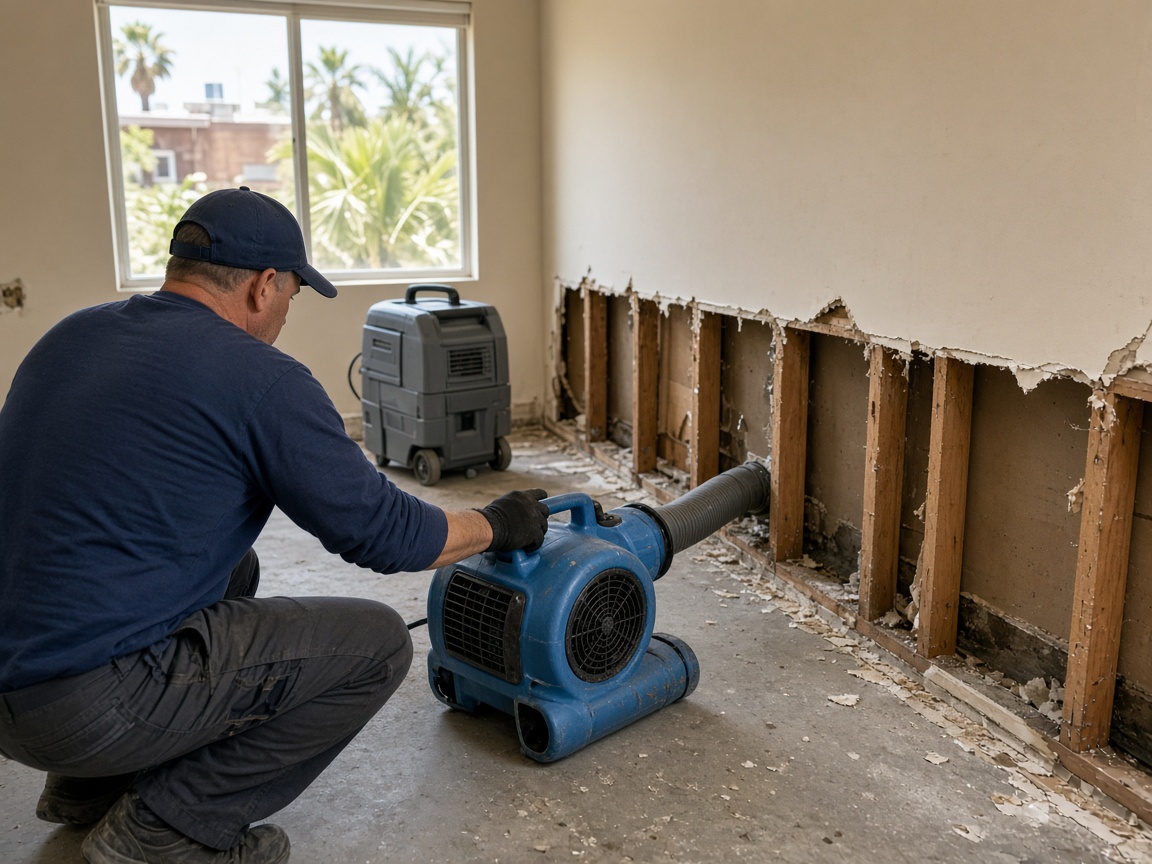
Riverside's older housing stock, especially pre-1970 homes in Magnolia Center and Arlington, often features plaster over wood lath or early gypsum that holds water longer than modern materials. After a slab leak or roof intrusion during the rare winter rains, crews must pull baseboards, create weep holes, and run directed airflow behind walls rather than simply placing fans in the center of a room. Skipping these steps leaves moisture trapped against stucco-clad exteriors common in La Sierra, allowing mold to form within 48 hours even when surface readings appear dry.
Hot-summer Mediterranean conditions with very low summer humidity help final drying once equipment is placed correctly, but the same dry air can mask ongoing moisture migration from soil beneath concrete slabs. Technicians use penetrating probes and thermal imaging to map saturation in garages and utility rooms where many Riverside homes lack vapor barriers. When water reaches neighboring properties in denser neighborhoods near the Mission Inn, containment barriers and negative air setups prevent cross-contamination while complying with Riverside County building department expectations for documented moisture logs.
Edge cases arise after flash flooding from the Santa Ana River corridor or when HVAC condensation lines back up into attic insulation. In these situations, crews remove wet cellulose, treat affected joists with antimicrobial rinses only where visible growth exists, and document every reading for insurance adjusters. Homeowners who attempt to dry structures with box fans alone frequently discover recurring musty odors months later because hidden cavities never reached the required 16 percent moisture content threshold.
Technician insight
In Riverside the thing that catches most people out with structural drying is older plaster walls in Arlington and Magnolia Center homes. Once water gets behind the lath it travels horizontally along the wood and never shows on the surface until you pull trim. The dry summer air tricks homeowners into thinking everything is fine when the cavities are still above 20 percent.
Hidden Moisture Behind Plaster in Arlington
A kitchen supply line leaked for several days in a 1960s Arlington home. Surface drywall felt dry but probes showed saturation in the plaster behind cabinets. Crews removed baseboards, installed air movers into the wall cavities, and ran dehumidifiers for five days until readings dropped below 12 percent. No mold developed and the homeowner avoided full wall replacement.
Structural Drying Services We Offer
✓Moisture Mapping and Assessment
Technicians use penetrating meters and infrared cameras to locate hidden saturation in walls, floors, and ceilings before equipment placement.
✓Industrial Dehumidification
High-capacity LGR dehumidifiers sized for Riverside's dry climate pull remaining moisture from framing and concrete without over-drying finishes.
✓Air Mover and Airflow Setup
Directed airflow patterns are created behind walls and under cabinets to reach cavities that standard fan placement misses in older Arlington homes.
✓Slab and Subfloor Drying
Specialized mats and injectors address moisture trapped beneath concrete slabs common in La Sierra and Magnolia Center properties.
✓Daily Monitoring and Documentation
Readings are logged each visit with photos and moisture percentages for insurance claims and Riverside County compliance records.
Structural Drying Cost in Riverside, CA
| Service | Typical Range | What Affects It |
|---|---|---|
| Single Room Structural Drying | $650–$1,200 | Varies with wall cavity access and days needed |
| Whole-House Drying | $2,800–$5,500 | Multiple levels or slab involvement increases range |
| Slab Edge Drying Add-On | $450–$850 | Required when water migrates under concrete |
Ranges are typical for Riverside, CA and confirmed with an exact written quote before any work starts.
How it works
- 1
On-Site Assessment
Technicians inspect the affected structure, test moisture levels in multiple materials, and identify hidden water paths in Riverside homes.
- 2
Containment And Equipment Placement
Barriers isolate the work area while dehumidifiers and air movers are positioned to reach wall cavities and slab edges.
- 3
Ongoing Monitoring
Daily visits track moisture reduction until all structural materials reach acceptable drying goals for the local climate.
- 4
Final Verification And Breakdown
Final readings and documentation are provided before equipment removal and area cleanup.
Pricing
Costs depend on square footage affected, depth of saturation, and number of days required; upfront quotes provided after inspection.